

For this church:  |
|
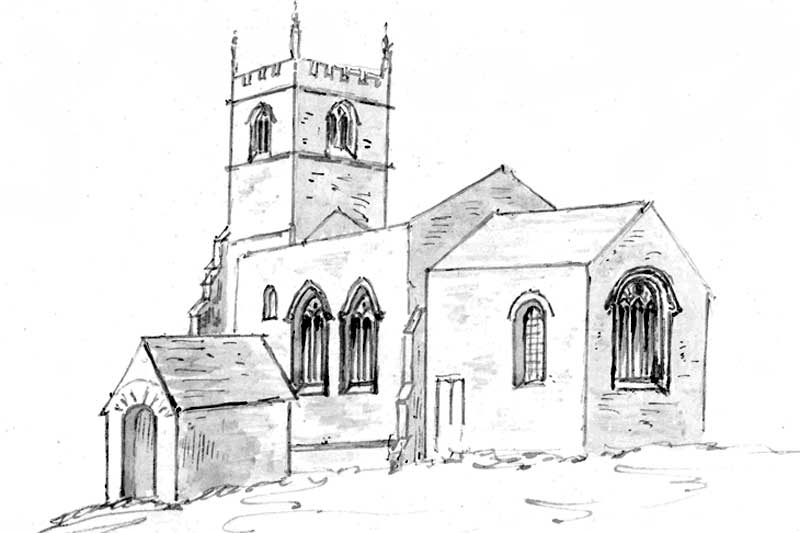 A sketch of the church A sketch of the churchby the Rev R Evans (made before 1845) |
By 1832 the earlier church was described as “an ancient edifice” but with no mention of its condition. Cox, writing in 1912, recorded that the old church had been ‘long dilapidated’ but the source for this comment is not given. By this time a new church had been built which he praised.
Henry Pelham Fiennes Pelham-Clinton, 4th Duke of Newcastle-under-Lyne, financed the building of the new church. He wrote in his diary on 1st June 1822, of his deceased first born child, “I propose to remove her remains to Bothamsall when I shall have completed the church and family vault there.” By the year end his wife and a new born child were also dead. All were placed in the vault at Bothamsall church pending the rebuilding. The architect, Sir Robert Smirke, was engaged in 1823, to design and supervise the project but on 25th February 1824 the whole scheme changed and work began on a church and mausoleum at Milton some miles away.
This was sufficiently completed by 1836 for the remains of the duchess and her children to be transferred from Bothamsall church which was not to be rebuilt until 1845.
The Present Church
In 1839 Worksop Manor was purchased by the Duke, and, partly on the advice of his visitor, Sir Robert Peel, the demolition took place. There was therefore an ample supply of stone available when work began at Bothamsall but some of this stone also went into the building of the new vicarage (now known as Bothamsall Hall) as well as into the church. In his diary for 8th June 1844 the Duke wrote of “an excellent bed of stone” in Bothamsall which he also intended to use in the rebuild. The incumbent, the Rev Henry Fiennes-Clinton, concluded his return for the 1851 religious census with the comment that the church was built “exactly on the same site and with a great portion of the old materials”. This latter comment tends to be confirmed nowadays by a close examination of some well-worn fabric.
The architect chosen was Andrew Trimen, Adelphi, London. This is borne out by several letters from ‘miscellaneous correspondence’ to the Duke of Newcastle regarding payments, materials, etc. At one point Trimen suggests that the Duke’s coat of arms be carved in stone and inserted in a ‘sunk island’ above the tower door of Bothamsall church. This was not carried out.
The Duke records his pleasure at seeing the church completed in diary entries during 1844-5: “The church at Bothamsall is as near perfect as can be … quite a model for a village church … it is really beautiful” he wrote on 21st November 1844; “I ne’er saw a church of its size that pleases me better” on 25th November 1844; and then on 3rd January 1845 he recorded that he was “more than ever pleased with it …”.
The church was finally reopened for worship on 20th April 1845 when pews had been allocated satisfactorily.
Soon after this the work became less pleasing to the Duke. “Found the builder’s work at the church miserably ill done, so rough and ill laid as to be most unsightly if examined into”, he wrote on 13th June 1845, and with the passage of time he was increasingly irritated: “No work could be worse executed than it is – the shameful scamping of the work now begins to show itself but too evidently, and in another season it will be infinitely worse.” (4th October 1845). Finally, he turned on the architect: “all Mr Trimen’s works are equally disgracefully erected” (24th November 1845).
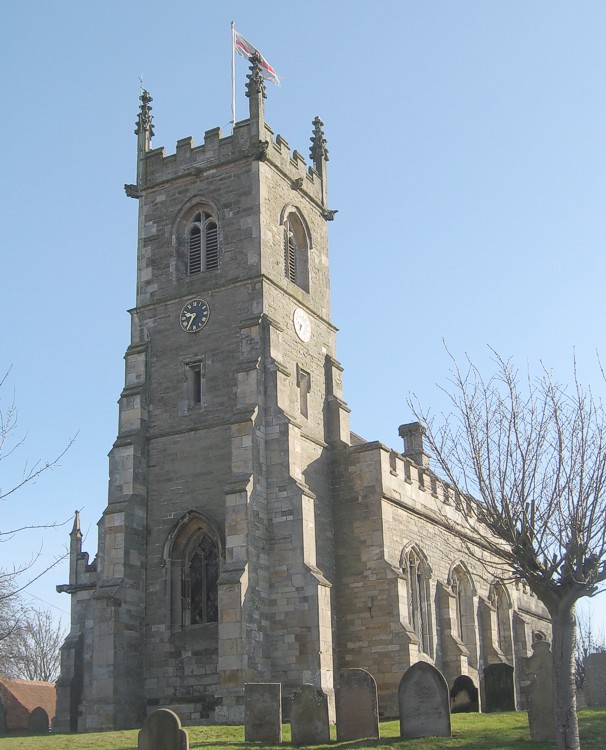
All written references agree that the church was rebuilt on the same site as the earlier building. It consists of chancel, nave, north aisle, tower and vestry and has been described as ‘a neat Gothic structure’ corresponding to the old as nearly as possible. A door in the north wall of the chancel leads to the vestry. There are two clear reasons to wonder whether a vestry may not have existed in the former building or at least that it had not existed prior to 1821. Firstly, the raised tomb of Henry Walters (d1689) is now rather incongruously placed in that vestry. Secondly, the grave-marker of Sir Charles Craufurd (d1821), a distinguished soldier and husband to the Dowager Duchess of Newcastle, is placed virtually in the doorway to the vestry and hardly reflects there his importance in local society. The presence of two much older grave-markers bearing crosses in the centre of the chancel suggests there was very little re-arrangement of the flooring at the rebuild and therefore we must presume Sir Charles’ stone was left in its original position. Possibly the old church’s north-west corner contained a chapel or the north aisle continued the length of the church with some partitioning between it and the chancel. Walters’ tomb would then be placed on the northern side of the partition which is more likely.
During the rebuild, a vicarage was built some 200 meters to the east of the church.
The first incumbent was the Rev Henry Fiennes-Clinton, a relative of the Duke of Newcastle. In 1851 he noted that the population was 319, that the parishioners had contributed £100 to the building of the new church. Seating was provided for 350 individuals and 100 of the seats were free. This was an increase of 50 seats over the old church. On 30th March 1851 the day of the census, Fiennes-Clinton recorded 150 attending with an additional 50 Sunday scholars. Bothamsall was comfortably above the 40% norm for estate villages: in 1851 38% of land in Nottinghamshire was on estates where there was only one owner (apart from glebe land). This percentage was the third highest in the country. In villages on estates the attendance was calculated to be 40%. The Duke of Newcastle owned four villages on his Clumber estate and the returns show he was successful in keeping non-conformist places of worship out of three of them.
In 1879 the 7th Duke succeeded to the title at the age of 15. Studying later at Magdalen College, Oxford he came under the influence of the the Anglo-Catholic movement and it remained the dominant influence on his life. When in London he worshipped at All Saints’, Margaret Street. To him we are indebted for Bodley’s magnificent chapel in Clumber, begun in 1886, and the financing of Comper’s work at Our Lady of Egmanton in 1897.
On the eve of the war, in 1912, visitation returns show the benefice income for Bothamsall stood at £50 but the vicar now also had the income from Elkesley. Perhaps surprisingly, the seating capacity for Bothamsall is now given as 200 some 150 seats less than in 1851 just after the church was rebuilt. Sunday school attendance at 47 showed very little reduction from the figure recorded at the 1851 religious census (50 Sunday scholars).
A handwritten note found among vestry papers, and probably intended for magazine or newspaper report recorded a sale of work at Easter 1917 opened by the Duchess in the schoolroom – a room “gay with flags.” The work was mainly done by the schoolchilden and Miss Atkins, their teacher. The sale was in aid of the Red Cross, Belgian children and to raise funds to send parcels to local men serving in the War. It records that the Duchess had an interest in the Red Cross and had just returned from helping in that capacity in London. She had gone round tables and “made liberal purchases”. Children sang nursery rhymes directed by Miss Atkins and accompanied by Miss Helen Peck, the churchwarden’s daughter.
In the early 20th century the Duke presented the patronage of some local churches to the Society for the Maintenance of the Faith, of which he was president from 1911 to his death in 1928. In 1924 Bothamsall church was consequently transferred to their patronage. At the time of this change the church became dedicated to Our Lady and St Peter. Subsequently clergy in the Anglo-Catholic tradition were appointed to the living.
In 1945 the Rev D D Woodgate, an Anglo-Catholic, came to Bothamsall. A villager reported that the faint turquoise colouring on the upper part of the arcade columns is the remains of the painting of the church that the Rev Woodgate financed himself, making the church very colourful. At this period it had a Lady Chapel at the east end of the north aisle with a statue of Our Lady on the altar.
After a long period of 140 years with little maintenance carried out, a faculty was obtained in 1982 to carry out extensive work inside and outside the church which involved, internally, the restoration of the north aisle. The floor was flagged, walls replastered and painted, the heating system updated and the building was rewired. Monuments were secured and the font removed from the rear of the nave to a position in the north aisle. The area beneath the tower was redecorated. The faculty also allowed for the ‘removal of a recent rood beam’ which had presumably been erected since 1924. The crucifix was to be suspended from the chancel arch. This work culminated in an Order of Service for the Rehallowing of the restored interior of the church conducted by the Rt Revd Denis Wakeling, Bishop of Southwell on 29th June 1983.
There followed in the 1990s work to repair the bells and to install a new organ at the eastern end of the north aisle at which time the Lady chapel was completely removed.
Over a longer period external work was carried out to the structure of the tower. Other stonework was repaired or, where specified by the Diocesan Architect, replaced. Drains and gutters were repaired. The entrance gates were repaired and handrails and lighting provided at the steps.
In 2002 further redecoration was completed and electrical work carried out.
Introduction | Location | History | Archaeology | Contacts
Fittings | Glass | Organ | Bells | Clock | Stonework | Monuments | War Memorial | Churchyard
References | Pictures | Plans | Listing Description | List of Incumbents
Project: Home | Index | About | People | What's new | Resources
 |  |  |  |